Showing posts with label singapore wood shrimp. Show all posts

Tuesday, March 17, 2009

The Quest to Breed Singapore Wood Shrimp, Day 28


No news to report. Things are much the same.


I haven't shot new images or videos since last Friday, because everything looks the same. This is a shot from Friday March 13th. The only behavioral change I see if that she is not as enthusiatic about beating her pleopods, although she does do that. One thing I haven't mentioned before that I find interesting happens when I am feeding her. Since she is now in a 10 gal tank, I am feeding her using either a small piece of airline hose, when I feed her Cyclop-eeze, or a drinking straw when I am feeding her flake food. This is so I can direct the feed right to where she is instead of it disoursing everywhere. If a large quantity of food gets near the eggs, she beats her pleopods wildly to get the food away from the eggs.


Isn't nature interesting?


I am SOOOOO ready for these eggs to hatch.

Wednesday, February 25, 2009

The Quest, Day 6

I’m beginning to understand why people don’t have success with breeding Singapore Wood Shrimp! Lack of funds, lack of knowledge, lack of time.

Brian Dorn Husbandry Curator at North Carolina Aquarium at Pine Knoll Shores has been a great sport- while he says he knows little or nothing about breeding Singapore Wood Shrimp, we’ve exchanged several emails that have been quite helpful to me. I am only moderately knowledgeable about the kinds of life-forms I work with in my home, but underneath that is a whole layer of microscopic life forms and chemistry of which I was somewhat aware, but blissfully ignorant.

He suggested http://www.aquaticeco.com/ a company in Florida that sells all manner of things related to plankton (and other things). One option is a larval diet- a mixture of processed foods for fish and invertebrate larvae. The smallest amount available is $25 plus shipping. The other route, to purchase rotifer cysts ($15) and algae culture ($15) would get me started with culturing live food. Brian said that tech support was great- so I called.

We talked for a long time, and Brian was right, tech support was very knowledgeable and patient with all my questions. He, too, indicated that if I had a tub of algae outside, the zoo-plankton would follow.

As of yesterday, I couldn’t really decide what to do. But late last night I was reading two excellent articles in the Advanced Aquarists Online Magazine about culturing rotifers. Not only did it start sounding like something I could easily fail at (thus having no food for the larvae), but there was a reference that rotifers might actually be too large for some fish fry. Well if they’re too large for some fish fry, I would well imagine they could well be too large for shrimp fry. In the next article (http://www.advancedaquarist.com/issues/oct2002/breeder.htm) he was talking about other ciliates.

While it didn’t exactly tell me where to get the ciliates, he did provide a nice recipe for something to feed the ciliates, using vegetable juice and some vitamins I have around the house. Also, the Aquatic Eco guy was talking about how careful you had to be with your algae culture that it didn’t get contaminated with ciliates. Hmm, I thought, this is sounding more like what might work. Just then, as I reading the end of the article, I got another message Jirkalib of the Czech Republic. He and I have been emailing almost daily. I found him back when I was doing google searches for information. He had found himself in the same predicament about 10 months ago- and posted questions about what to do, and got no good answers. As it happened, he posted an excellent video on YouTube http://www.youtube.com/watch?v=pYsnA-RCJE4&feature=channel_page, and since I have a YouTube account, I was able to message him.

He had no success with his larvae, but I have been asking as many questions as I can to learn what I can from his experience. More on this later. But he had mentioned the prior day that he had plankton to feed them with, and just as I was finishing the article I got a message from him that it was a culture he grew with just regular straw and water. So that is what I’m going to try. So, as of today, my basic food strategy is:

  • Hope for an algae bloom in the tanks I’m putting mollies in- I at least know I have algae around
  • Start a straw-water culture
  • Buy some plankton food meant for corals and the like
  • Have brine shrimp eggs on hand


Today I’m acclimating mollies. It’s taking a lot longer than I thought.

Sunday, February 22, 2009

The Quest day 3


Emailed several folks who had posted about their Wood Shrimp being berried up with eggs. Didn't hear anything from most- one suggested I try to use Amano directions.

I went to a Pet store in Marysville, WA that has a lot of Salt Water aquariums and asked for advice. The article (referenced yesterday) mentioned that he had first tried 17 ppm salt- which is brackish at the high end with no survivors. Then in a different batch tried full salinity, and had survivors. He also talked about having “green water” with plankton to feed them. Clearly that is going to be required no matter what level of salinity is going to be used.

The woman at the Pet Store, who, I was told, was the most knowledgeable of all the employees talked with me almost an hour. She said that like in freshwater, things like algae just manage to start growing in salt water, but that it would be completely different species. I asked about using regular gravel (I was thinking about avoiding cycling issues), and in the course of the conversation, she told me that the bacterial base for salt water, again, like algae, is a completely different set of species.

It occurred to me that this may be one key ingredient that has prevented successful attempts.

She also said that regular gravel would not do- that it really needed to be a regular salt water media, like crushed coral, in order to buffer the pH properly. It occurred to me that this, too, might be an important consideration.

So some $70 later, I left the store with:


  • 15 lbs of Florida crushed coral (smallest bag available- but at least 3 times what I needed)

  • Instant Ocean- enough for 10 gals

  • Hydrometer for measuring salinity

  • Instant Ocean Bio-Spira bacteria- enough for 30 gals, but again, smallest amount available

  • Brine Shrimp eggs (just in case these prove to be small enough for food.)

They had no live plankton of any kind. There were both phyto and zoo plankton products available, but all were dead.

I spent the better part of the evening trying to figure out a process and space arrangement. Finally I decided not to sacrifice the System 3 to salt. It was a hard decision, but in the end, I realized that if I had any success with these eggs, they will need a place to live… if I allow the bio-wheel to acclimate to the salt, then there will be a period of time when it is re-cycling to fresh.

The Pet Store woman suggest I email some aquariums to see if I could find anyone with information, so I spent 2-3 hours with a google listing of aquariums, and emailed 34 (+ about 5 that had web forms) aquariums throughout the United States asking if anyone had any information.

So this is the set up (next day-Feb 22, 2009)


  • A small world 2 gal- with actually 2 gal-2 cups- totally salt- 30 ppm

  • A jar that holds 10 cups- brackish*

  • A small, small work that holds 7 cups- fresh water.

Photos: at the top is the set up with all four (chair is the sytem 3 I didn't want to change to salt- more on this later).
This is the little small world- holds just under two gallons.


There is a little filter, which usually holds a small carbon filter- I replaced that with a partial bio-sponge. I don't want to filter out all the plankton, I just want to make sure there is a place for bacteria to colonize.


The substrate of Florida coral- washed thoroughly. I chose a plastic plant, because there aren't live plants that I have around that would survive the 30 ppm salinity range.


The next tank is brackish. I looked on the web for appropriate substrate, and found a nice site that said well washed play sand is appropriate. That felt right, and I had some left over from the goldfish ponds, so I rinsed it well, and it ends up being just under an inch.


The filtration is just a little trick I learned (more on this later) with a piece of pvc, a small portion of a bio sponge, and an airstone.


I tried to make this about 17 ppm, but am having some issues in measuring this- more on this later too.
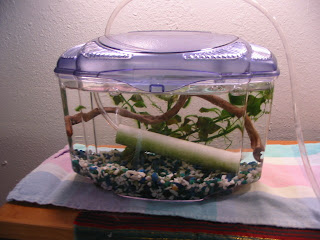


Finally, this last one, a tiny- tiny small worls ($2.99 at a thrift sotre) holds 7 cups. This is just fresh water, with some live plant taken from the parent shrimp's tank today. It has a nice algal growth. This, my intention anyway, will be where I move Mom just before she sheds the eggs. I'm using another pvc filter. The wood you see is another piece of the same root that a larger portion of is in her home now. These shrimp love to have a perch where they can take advantage of the water flow. The gravel is from a recently dismanteled 10 gal, and should have a healthy bed of bacteria.

The Quest to successfully breed

Feb 20th, 2009

I’m on a hunting adventure for someone who is knowledgeable about breeding Singapore Wood shrimp. I’ve had two of these little critters for a couple of years now and never saw any signs of breeding activity. I assumed I didn’t have a breeding pair, which was okay with me, because I know they’re not easy like the NeoCaridinas. But lo and behold last night there was a molting, and I noticed the shrimp was very, very red, more so than usual after a molting. As I was about to shut the lights down, I was hunting around for the carapace, and found that she was plump with eggs.

So, obviously I’m under some time constraint. But I can’t even find any information about how long they hold their eggs, let along any information about salinity levels or timing.

I have just read an excellent article about breeding Amanos, and emailed the author hoping for some info on Singapore Wood ship. The article is at http://caridina.japonica.online.fr/English/Elevage.htm. I need that article exactly -- only for Wood Shrimp!